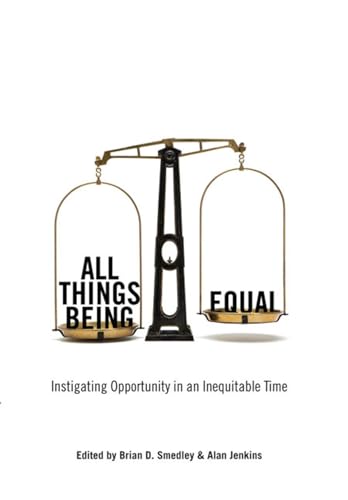
All Things Being Equal: Instigating Opportunity in an Inequitable Time
Product Description
Condition - Very Good
The item shows wear from consistent use but remains in good condition. It may arrive with damaged packaging or be repackaged.
All Things Being Equal: Instigating Opportunity in an Inequitable Time
- Used Book in Good Condition
When we talk about uninsured kids, dozens to a classroom, being taught by teachers with no expertise in their field; about mass incarceration with no rehabilitation; about real estate brokers or employment firms that continue to discriminate into the twenty-first century; about housing programs that reinforce segregation and fail to connect willing workers with the employers who need them, we are mainly talking about failures of opportunity.
Contrary to popular belief, opportunity in America is in crisis. Class mobility is at an all-time low, the wage gap is through the roof, and Horatio Algers are few and far between. This and other critical ideas about the state of opportunity are documented in All Things Being Equal, a smart new book from a smart new outfit whose mission is to increase opportunity for all Americans.
Half critique, half all-important road map for the future, All Things Being Equal includes eight original essays by top-notch thinkers pointing to areas in American life where opportunity is missing and showing us how to instigate it.
Featuring:
- Jared Bernstein, “You Can Take It with You: Income and Wealth Across Generationsâ€
- Linda Darling-Hammond, “Educational Quality and Equality: What It Will Take to Leave No Child Behind"
- Marc Mauer, “Reducing Incarceration to Expand Opportunityâ€
- Brian D. Smedley, “Why Health-Care Equity Is Essential to Opportunity—and How to Get Thereâ€
- Philip Tegeler, “Connecting Families to Opportunity: The Next Generation of Housing Mobility Policyâ€
- Edward E. Telles and Vilma Ortiz, “Finding America: Creating Educational Opportunity for our Newest Citizensâ€
- Margery Austin Turner and Carla Herbig, “Measuring the Extent and Forms of Discrimination in the Marketplace: Lessons from Paired-Testing Researchâ€
Technical Specifications
You might also like

The Civically Engaged Reader: A Diverse Collection of Short Provocative Readings on Civic Activity

The Impossible Will Take a Little While: A Citizen's Guide to Hope in a Time of Fear

Avoiding Corporate Breakdowns: The Nature and Extent of Managerial Responsibility

The Ethics of Management

An Introduction to Business Ethics

Understanding Management

The Business Writer's Companion

The Responsible Company: What We've Learned From Patagonia's First 40 Years

The Ethics of Management

Principles of Marketing (15th Edition)