
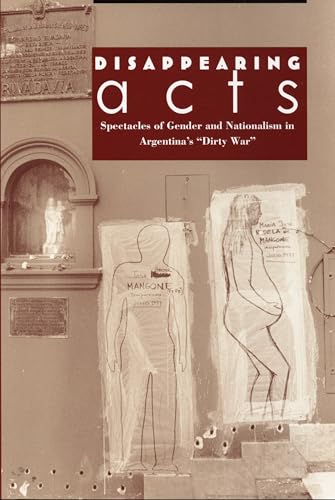
Disappearing Acts: Spectacles of Gender and Nationalism in Argentina's "Dirty War"



Description
Condition - Very Good
The item shows wear from consistent use but remains in good condition. It may arrive with damaged packaging or be repackaged.
- Used Book in Good Condition
In Disappearing Acts, Diana Taylor looks at how national identity is shaped, gendered, and contested through spectacle and spectatorship. The specific identity in question is that of Argentina, and Taylor’s focus is directed toward the years 1976 to 1983 in which the Argentine armed forces were pitted against the Argentine people in that nation’s "Dirty War." Combining feminism, cultural studies, and performance theory, Taylor analyzes the political spectacles that comprised the war—concentration camps, torture, "disappearances"—as well as the rise of theatrical productions, demonstrations, and other performative practices that attempted to resist and subvert the Argentine military.
Taylor uses performance theory to explore how public spectacle both builds and dismantles a sense of national and gender identity. Here, nation is understood as a product of communal "imaginings" that are rehearsed, written, and staged—and spectacle is the desiring machine at work in those imaginings. Taylor argues that the founding scenario of Argentineness stages the struggle for national identity as a battle between men—fought on, over, and through the feminine body of the Motherland. She shows how the military’s representations of itself as the model of national authenticity established the parameters of the conflict in the 70s and 80s, feminized the enemy, and positioned the public—limiting its ability to respond. Those who challenged the dictatorship, from the Mothers of the Plaza de Mayo to progressive theater practitioners, found themselves in what Taylor describes as "bad scripts." Describing the images, myths, performances, and explanatory narratives that have informed Argentina’s national drama, Disappearing Acts offers a telling analysis of the aesthetics of violence and the disappearance of civil society during Argentina’s spectacle of terror.
Shipping & Delivery
Your order is shipped from the USA and delivered to your door in South Africa in 10–20 working days. All items are fully tracked.
Returns & Exchanges
We offer a 30-day return window. If something isn't right, contact our support team and we'll make it right.


