
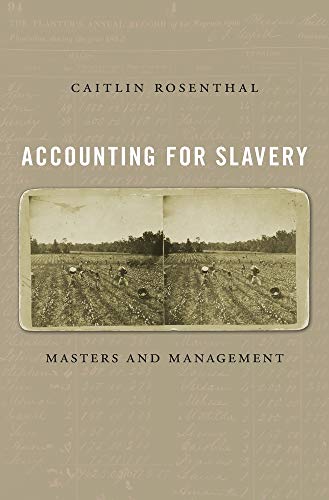
Accounting for Slavery: Masters and Management

Product Description
Condition - Very Good
The item shows wear from consistent use but remains in good condition. It may arrive with damaged packaging or be repackaged.
Accounting for Slavery: Masters and Management
“Slavery in the United States was a business. A morally reprehensible―and very profitable business…Rosenthal argues that slaveholders in the American South and Caribbean were using advanced management and accounting techniques long before their northern counterparts. Techniques that are still used by businesses today.â€
―Marketplace
A Politico Great Weekend Read
Accounting for Slavery is a unique contribution to the decades-long effort to understand New World slavery’s complex relationship with capitalism. Through careful analysis of plantation records, Caitlin Rosenthal explores the development of quantitative management practices on West Indian and Southern plantations. She shows how planter-capitalists built sophisticated organizational structures and even practiced an early form of scientific management. They subjected enslaved people to experiments, such as allocating and reallocating labor from crop to crop, planning meals and lodging, and carefully recording daily productivity. The incentive strategies they crafted offered rewards but also threatened brutal punishment.
The traditional story of modern management focuses on the factories of England and New England, but Rosenthal demonstrates that investors in West Indian and Southern plantations used complex accounting practices, sometimes before their Northern counterparts. For example, some planters depreciated their human capital decades before the practice was a widely used accounting technique. Contrary to narratives that depict slavery as a barrier to innovation, Accounting for Slavery explains how elite planters turned their power over enslaved people into a productivity advantage. The brutality of slavery was readily compatible with the development of new quantitative techniques for workforce organization.
By showing the many ways that business innovation can be a byproduct of bondage, Rosenthal further erodes the false boundary between capitalism and slavery and illuminates deep parallels between the outlooks of eighteenth- and nineteenth-century slaveholders and the ethical dilemmas facing twenty-first-century businesses.
Technical Specifications
You might also like

They Were Her Property: White Women as Slave Owners in the American South

Birthright Citizens: A History of Race and Rights in Antebellum America (Studies in Legal History)

The Common Wind: Afro-American Currents in the Age of the Haitian Revolution

No Property in Man: Slavery and Antislavery at the Nation’s Founding (The Nathan I. Huggins Lectures)

Sexuality and Slavery: Reclaiming Intimate Histories in the Americas (Gender and Slavery Ser.)

African Kings and Black Slaves: Sovereignty and Dispossession in the Early Modern Atlantic (The Early Modern Americas)

The Price for Their Pound of Flesh: The Value of the Enslaved, from Womb to Grave, in the Building of a Nation

Wayward Lives, Beautiful Experiments: Intimate Histories of Social Upheaval

Temp: How American Work, American Business, and the American Dream Became Temporary

The War Before the War: Fugitive Slaves and the Struggle for America's Soul from the Revolution to the Civil War