
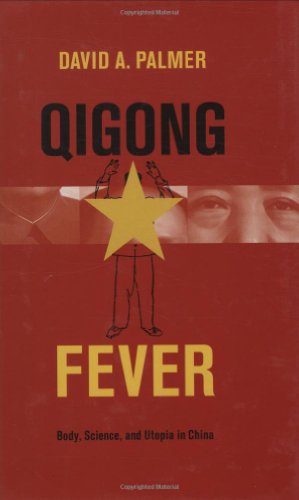
Qigong Fever: Body, Science, and Utopia in China
Product Description
Condition - Very Good
The item shows wear from consistent use but remains in good condition. It may arrive with damaged packaging or be repackaged.
Qigong Fever: Body, Science, and Utopia in China
Qigong—a regimen of body, breath, and mental training exercises—was one of the most widespread cultural and religious movements of late-twentieth-century urban China. The practice was promoted by senior Communist Party leaders as a uniquely Chinese healing tradition and as a harbinger of a new scientific revolution, yet the movement's mass popularity and the almost religious devotion of its followers led to its ruthless suppression.
In this absorbing and revealing book, David A. Palmer relies on a combination of historical, anthropological, and sociological perspectives to describe the spread of the qigong craze and its reflection of key trends that have shaped China since 1949, including the search for a national identity and an emphasis on the absolute authority of science. Qigong offered the promise of an all-powerful technology of the body rooted in the mysteries of Chinese culture. However, after 1995 the scientific underpinnings of qigong came under attack, its leaders were denounced as charlatans, and its networks of followers, notably Falungong, were suppressed as "evil cults."
According to Palmer, the success of the movement proves that a hugely important religious dimension not only survived under the CCP but was actively fostered, if not created, by high-ranking party members. Tracing the complex relationships among the masters, officials, scientists, practitioners, and ideologues involved in qigong, Palmer opens a fascinating window on the transformation of Chinese tradition as it evolved along with the Chinese state. As he brilliantly demonstrates, the rise and collapse of the qigong movement is key to understanding the politics and culture of post-Mao society.
Technical Specifications
You might also like

Chinese Medical Qigong

Chinese Healing Exercises: The Tradition of Daoyin (A Latitude 20 Book)

The Healing Promise of Qi: Creating Extraordinary Wellness Through Qigong and Tai Chi

Answers to Common Tai Chi and Qigong Questions

The Religious Question in Modern China

Essential Concepts of Tai Chi

Huang Di Nei Jing Ling Shu: The Ancient Classic on Needle Therapy